
Why Your Mind Never Switches Off (And How to Create Mental Silence)
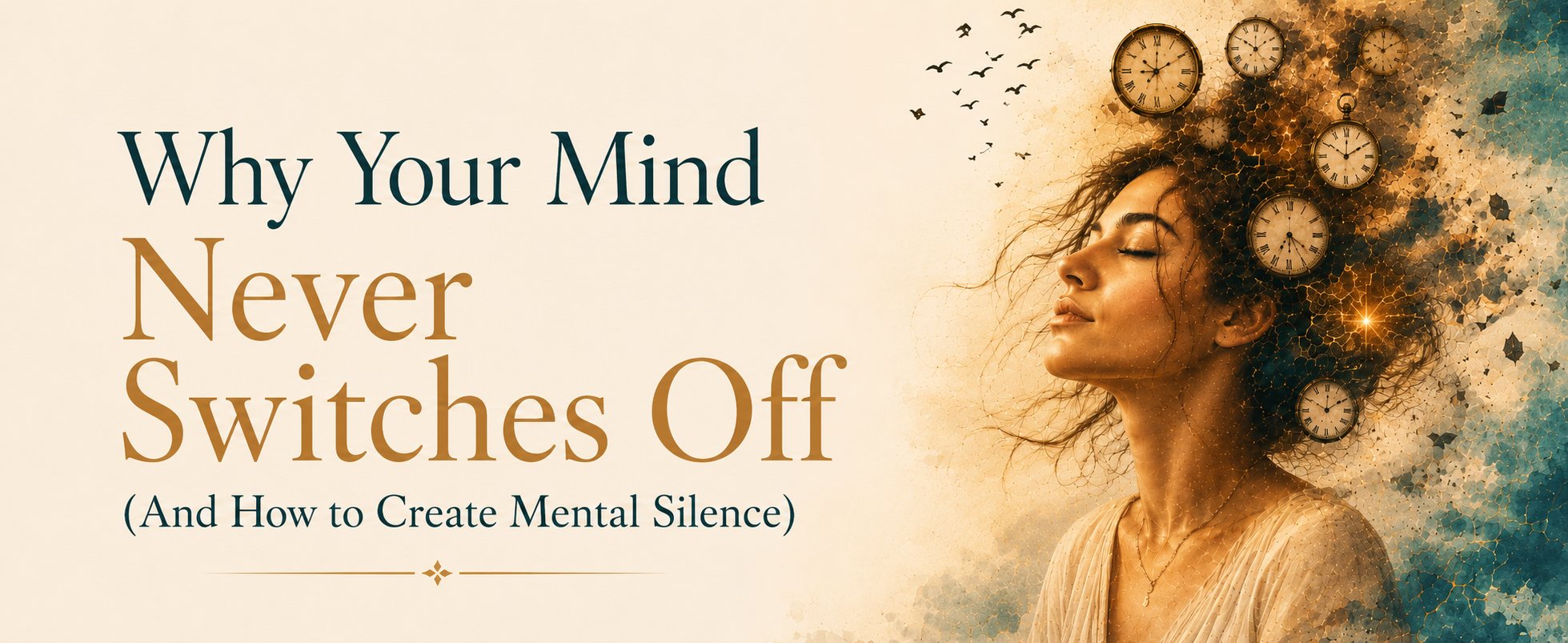
Do you ever feel like your mind is an engine that never idles? That constant background hum of worry, planning, replaying conversations, or anticipating the next challenge? We often convince ourselves that if we just think harder, analyze more, or find the right mental solution, we can finally quiet the mental noise.
Yet, for many people, the mind’s relentless activity is not a sign of high intelligence or productivity; it is a symptom of deeply ingrained programming. If you feel trapped in this mental loop, it's because what you perceive as your thoughts have transitioned from conscious choices into automatic reactions.The Mind as a Repetition Engine
Your brain is not a neutral space; it functions as a repetition engine that continuously shapes your reality.
Thoughts Become Wiring: Whatever you think most often ceases to be a fleeting thought; it settles into your cognitive framework and transforms into patterns that quietly influence your identity. Neuroscience explains this simply: neurons that fire together wire together. When you repeatedly entertain mental loops—such as constant worry, replaying conversations, or expecting things to go wrong—you reinforce the neural pathways for those specific narratives.
Trained Responses Masquerading as Reality: The brain is operating efficiently by reinforcing pathways it frequently uses, making them dominant in your thought processes. This is how a mental “normal” is created, causing thoughts to stop feeling like choices and start feeling like reality.
The Nervous System Override: The most significant reason your mind never truly switches off is that its activity is governed by your nervous system, which is often running on a survival program. Before your conscious mind can interpret a challenging situation, your nervous system has already initiated a response, bypassing higher-order thinking, reflection, and reasoning to prioritize speed and protection.
Stress as Internal Activation: Your body learns to recognize what “danger” feels like, even in the absence of an immediate threat. Once stress transforms into a learned pattern, it no longer requires an external trigger; your body can generate this response internally, automatically, and often without conscious awareness. This continuous, internal state of alertness fuels the relentless loop of mental activity.
How to Create the Pause and Break the Pattern
If awareness alone does not stop the cycle—which is often the case because awareness alone does not have the power to override biological processes—you must address the underlying system that dictates safety. True mental silence is not achieved by thinking harder; it is achieved by teaching your nervous system to relax.
The loop can be interrupted when you find the essential shift: The space between feeling and reaction, between trigger and response, and between pattern and identity.
1. Embrace Meditation as the Pause
Meditation is not about achieving perfection; it is about interrupting the automatic cycle of reaction.
Interrupt the Feed: By taking a moment to sit in stillness, you stop feeding every thought or emotion with an immediate reaction.
Recondition the System: Through consistent practice, the nervous system learns to relax and move out of a perpetual state of alertness. The same situations that previously elicited an emotional charge begin to diminish in their intensity.
Focus on the Body: Techniques like breath awareness or a body scan meditation help ground restless energy and facilitate the release of stress stored in the body, which is what often fuels the overactive mind.
2. Shift from Thinking to Observing
Genuine transformation is not possible when you are completely identified with a pattern.
The Power of Distance: When you stop resisting the mental noise and start understanding it, you begin to observe the patterns from a distance, allowing you to gradually cease repeating them.
Unlearning the Old: You are not striving to become a new person; you are unlearning the fear-based programming that was built through repetition.
This is where genuine change begins: not in an attempt to control life itself, but in learning to no longer be governed by your internal reactions to life’s circumstances.